
By Rebecca Ruth Gould
-
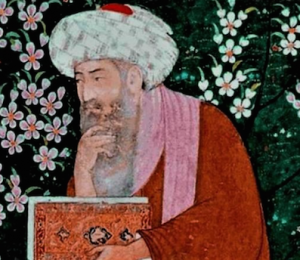
- painting of Ibn Arabi via InsideArabia
-
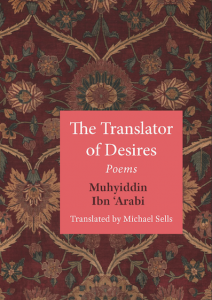
- Cover of The Translator of Desires: Poems
Michael Sells’s translation of Muhyiddin Ibn ‘Arabi, The Translator of Desires: Poems (released in April 2021) is the latest in a series of Sells’ translations of the Arabic classics, which begins with his rendering of the pre-Islamic odes called the Mu’allaqat. This translation is also the first complete English translation of Ibn Arabi’s Translator of Desires since 1911, when the British Orientalist Reynold Nicholson produced his complete translation of this work. Since Ibn Arabi’s 13th century lyric masterpiece has been theorized and commented on as philosophy more than it has been read as poetry, this new translation, which foregrounds the poetic qualities of the Arabic, is a welcome occasion.
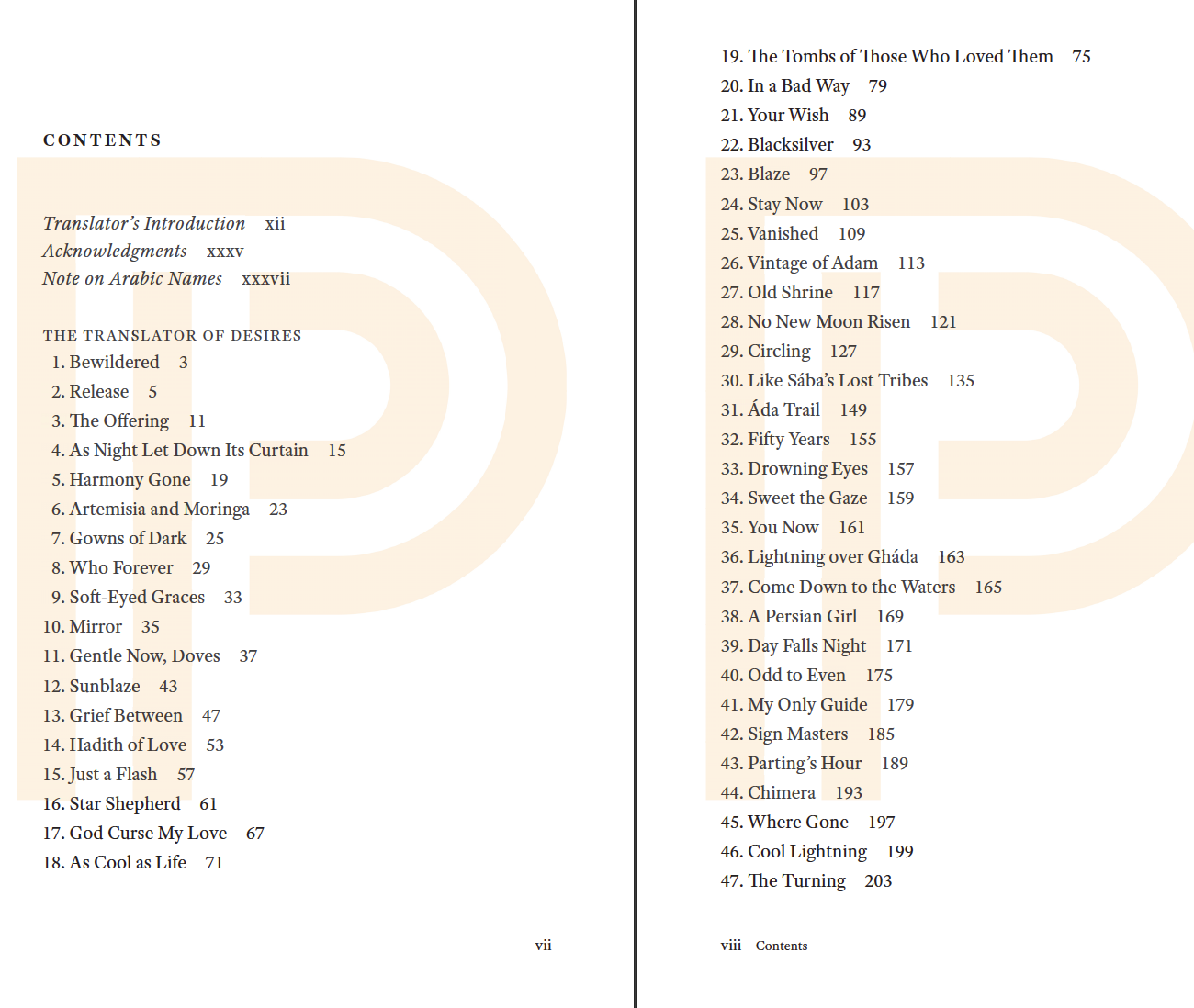
Table of Contents for The Translator of Desires: Poems (poem titles added by translator)
Ibn Arabi’s allegorical poem sequence revolves around a series of imaginary encounters between the poet and his beloved, an Iranian woman from Isfahan (called “Harmony” by Sells) whom he met while visiting Mecca. Their love is never consummated, and they become “Opposites never / to be joined — ” (19).
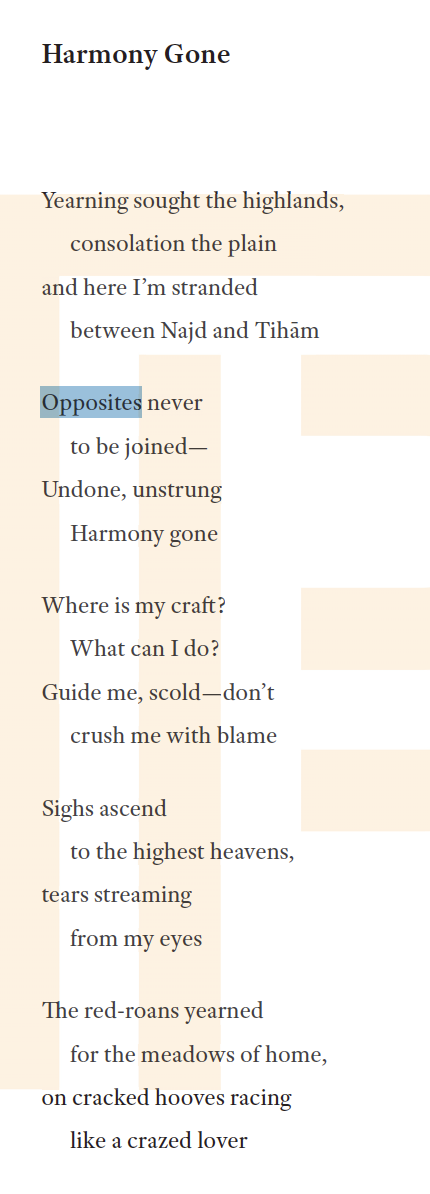
The Translator of Desires: Poems (“Harmony Gone,” p. 19)
Ibn Arabi’s allegorical rhapsodies will remind the reader of Dante’s Beatrice in La Vita Nuova and the Divine Comedy. As Sells comments, the poem cycle “consists of ever-repeated acts of reenchantment as the beloved is brought back to the present and the withered world is revived” (xxii).
Sells is bold in his translational methodology, especially when he departs from the exact lineation of the Arabic verses. His departures make sense; English uses an accentual metric system of fixed syllables, while Arabic meters are determined by the pattern of long and short syllables in a given verse.
In order to avoid creating a monotonous effect in English, Sells breaks his lines at shorter intervals. As a result, single lines in Arabic become two, three, or four lines in English. Sells’ choice pays off: these verses are more striking the Arabic line is broken more frequently. One example is the poem entitled (by Sells) “Who Forever”:
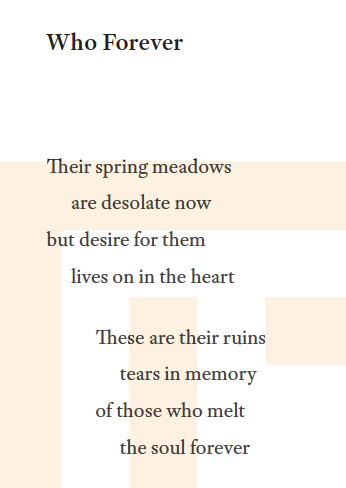
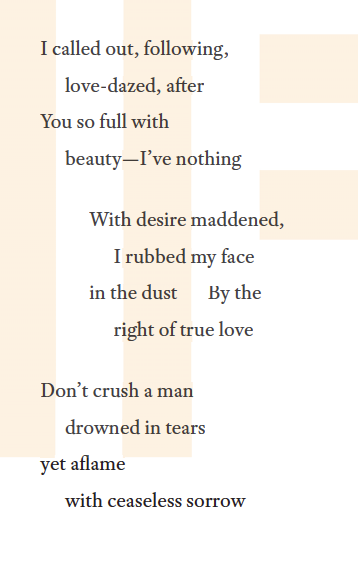
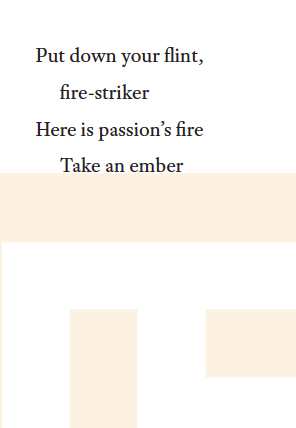
The Translator of Desires: Poems (“Who Forever,” pp. 29–31)
Aside from his prosodic innovations, Sells hews closely to the original. His adventurous and insightful rendering gives a new sense of concreteness to Ibn Arabi’s mystical verse.
Photo by svklimkin on Unsplash
A shorter version of this was published in Harriet Books, a blog of The Poetry Foundation. If you have a forthcoming poetry collection that you would like to have reviewed, make sure to submit it for consideration on Submittable.
For more reviews of Sufi-inspired poetry and other poetry from the Islamic world, see:
“How to belong to others without losing oneself
Threa Almontaser’s The Wild Fox of Yemen (2021)
medium.com
”
https://medium.com/global-literary-theory/re-enchanting-the-beloved-eebac902afd2
“The Magic Sewing Machine
Introducing the Persian Poems of Alam-Taj Zhale Qa’em-Maqami
medium.com
”
https://medium.com/global-literary-theory/re-enchanting-the-beloved-eebac902afd2
“Bijan Elahi, Five Scenes from Icarus
In the translation of Kayvan Tahmasebian and Rebecca Ruth Gould.
medium.com
”
https://medium.com/global-literary-theory/re-enchanting-the-beloved-eebac902afd2
